Three Days in Angkor, and Everything Beyond
I came to Cambodia for Angkor. For the temples, the history, the idea of a civilization preserved in stone. What I did not expect was how quickly that focus would shift. Away from what I had planned to see, toward things that were harder to name. Details. And the quiet sense that this was a place I had not yet understood.
The car stops in the dark. No streetlights, no buildings, just the sudden absence of movement. The driver gets out without saying anything, leaving the door slightly open behind him. For a moment, the situation shifts. I am no longer a tired traveler on the way to a hotel, but simply someone sitting in a place I cannot yet read. Alone in the dark.
A brief, precise thought: this is how my story ends.
Then he comes back. A phone in his hand. Later, he explains it as if it were nothing unusual: Drivers are not meant to operate freely within the airport zone. The tariffs are higher there, the system tightly controlled and rides are tracked via GPS. So they leave their phones outside. With friends, hidden somewhere along the road and collect them after the pickup. The moment dissolves as quickly as it appeared. What stays is not fear, but the realization that things here often function just beside official structures. And yet, over the next days, that initial tension fades almost completely. Moving through Siem Reap alone as a woman, I feel a kind of ease I had not expected. No one interferes, no one lingers too long. You move through the city, and you are allowed to move. People are consistently kind. There are moments, of course — market vendors insisting, trying a little too hard to sell — but even then, it never tips into discomfort. I did not feel unsafe, but welcomed.

Returning late on my first night in Siem Reap, I found a cat waiting outside my hotel room. She slipped inside as if she belonged there. And, as it turned out, she did: she was the hotel cat. Watching over me.
Learning to See Angkor
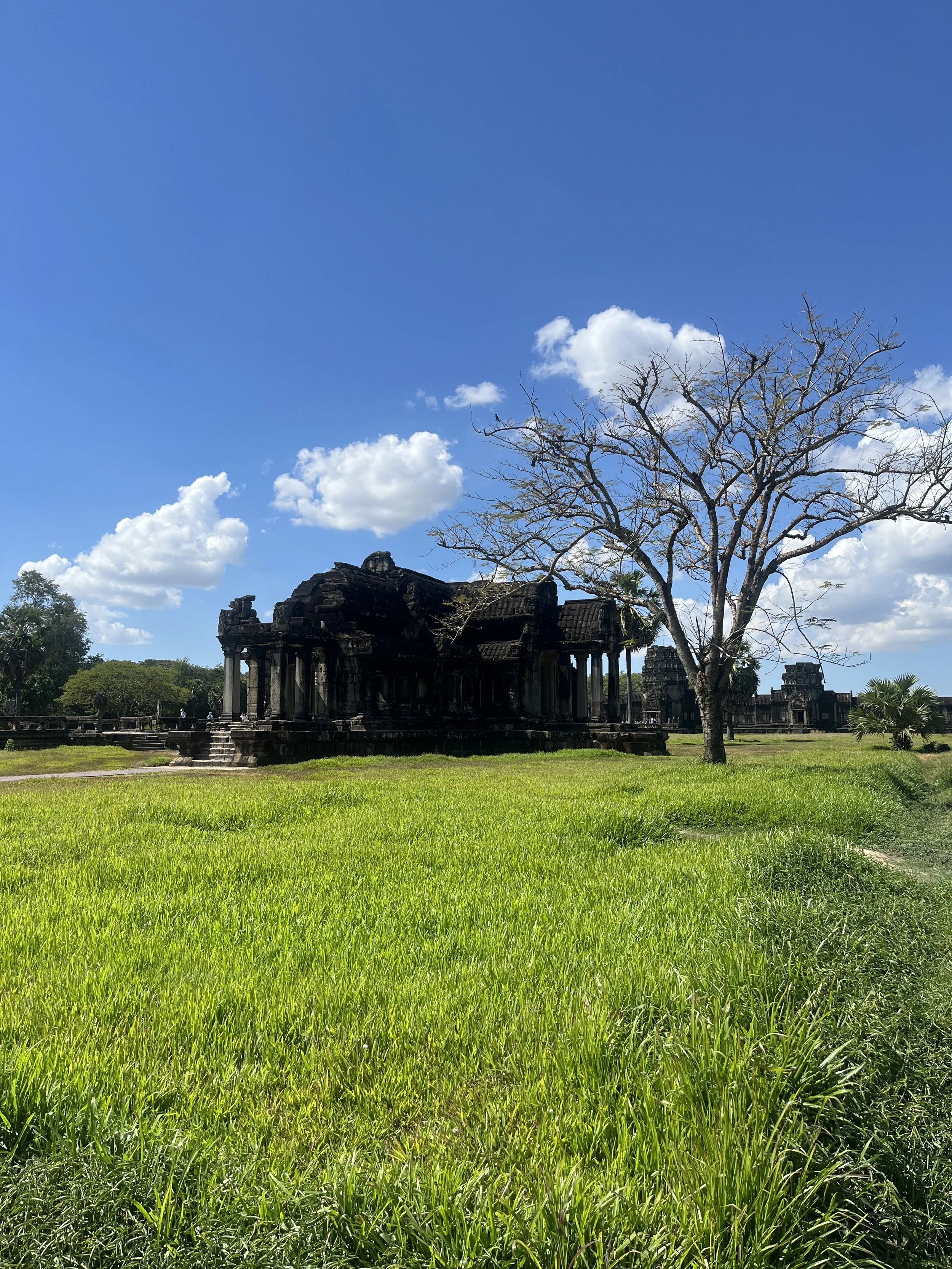
Most people think of Angkor as a single temple. Angkor Wat. Even the name reinforces that idea. “Wat” simply means temple. It sounds singular, contained, something you can see and move on from. It is not. Angkor is an entire landscape — over 400 square kilometers of temples, reservoirs, roads, and remains of what was once one of the largest cities of the pre-industrial world. What looks, from a distance, like a monument is in fact a system. Knowing this in theory is one thing. Understanding it requires a different kind of movement.
On the first day, I decide against doing it alone. Instead, I join a group tour. A bus, air conditioning, cold water handed out at regular stops. It feels slightly removed, almost too comfortable for a place like this. But in the heat, which settles quickly and stays, the cool air becomes less of a luxury and more of a condition for paying attention.
We move through the site in segments. From one temple to the next, with pauses that are timed, explained, structured. The guide provides the framework: 12th century, Suryavarman II, originally Hindu, later Buddhist. A city that may have supported close to a million people, sustained by an elaborate hydraulic system. It is efficient. And necessary. Without it, the scale would be difficult to grasp at all. And yet, something remains just out of reach. You see Angkor. But you don’t yet know how to look at it.
A Different Kind of History
It happens almost casually. We are standing in the shade between temples when our guide stops talking about kings and foundations and begins talking about language instead. “No English,” he says. “Chinese, yes. Russian, yes.”
The phrase is striking, but the history behind it is more complicated. Under the Khmer Rouge, who took Phnom Penh on 17 April 1975 and almost immediately emptied the cities, English and French were associated with the old educated classes and with the West; they were not neutral skills but potential liabilities. The regime tried to destroy existing social hierarchies and rebuild Cambodia as an agrarian revolutionary state, and education itself became dangerous. In other words, the guide’s phrase compresses years of fear and political realignment into one memorable sentence.
Between 1975 and 1979, the Khmer Rouge ruled Democratic Kampuchea under Pol Pot. An estimated 1.5 to 3 million people, often summarized as roughly a quarter of the population, died from execution, forced labor, starvation, and disease. The educated were especially vulnerable, but so were ethnic minorities, religious communities, and anyone who could be marked as insufficiently “pure” or politically suspect.
Our guide tells us that he learned in secret, in the jungle, with a teacher who knew what discovery could mean. That teacher, he says, is still alive. Now in his eighties, still teaching in the city. It is only a few sentences, but they change the atmosphere completely. Angkor no longer feels sealed inside the twelfth century. The temples remain ancient, but the voice explaining them belongs to a history that is painfully recent.
That is perhaps what is hardest to grasp from outside: how near this past still is. The Khmer Rouge period ended less than fifty years ago. For many people in Cambodia today, it is not abstract national history but family history. Something carried by parents, teachers, drivers, guides, and grandparents, often in fragments rather than in full stories. The country one moves through as a visitor is also a country that had to rebuild schools, institutions, and everyday trust after immense destruction. From that point on, I looked at the place differently. Not because Angkor itself had changed, but because the distance between past and present had collapsed. The grandeur of the Khmer Empire was still there in stone, but beside it stood another Cambodia: one marked by rupture, survival, and the fragile continuity of people who kept knowledge alive when knowledge itself had become dangerous. But isn’t it always?
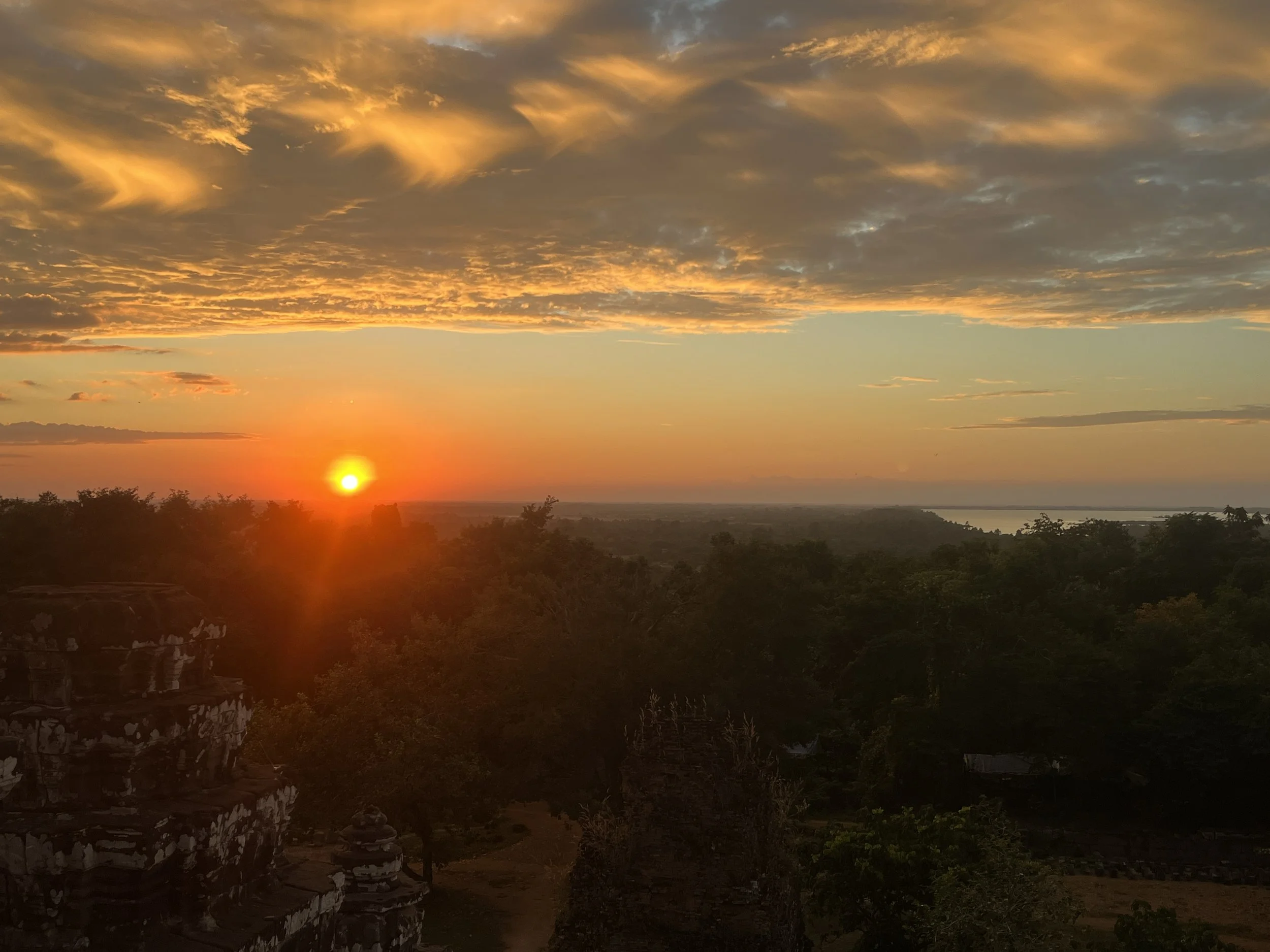
Moving Through Angkor
The next two days I returned on my own. After the group tour, that felt necessary. The first day had given me structure, scale, chronology. The useful outline. But Angkor is too large, too dense, to remain inside an outline for long. I wanted to move through it more slowly, without a schedule, without being carried from one major site to the next. So I hired a tuk-tuk and spent the days crossing the complex at a different pace.
That changed everything.
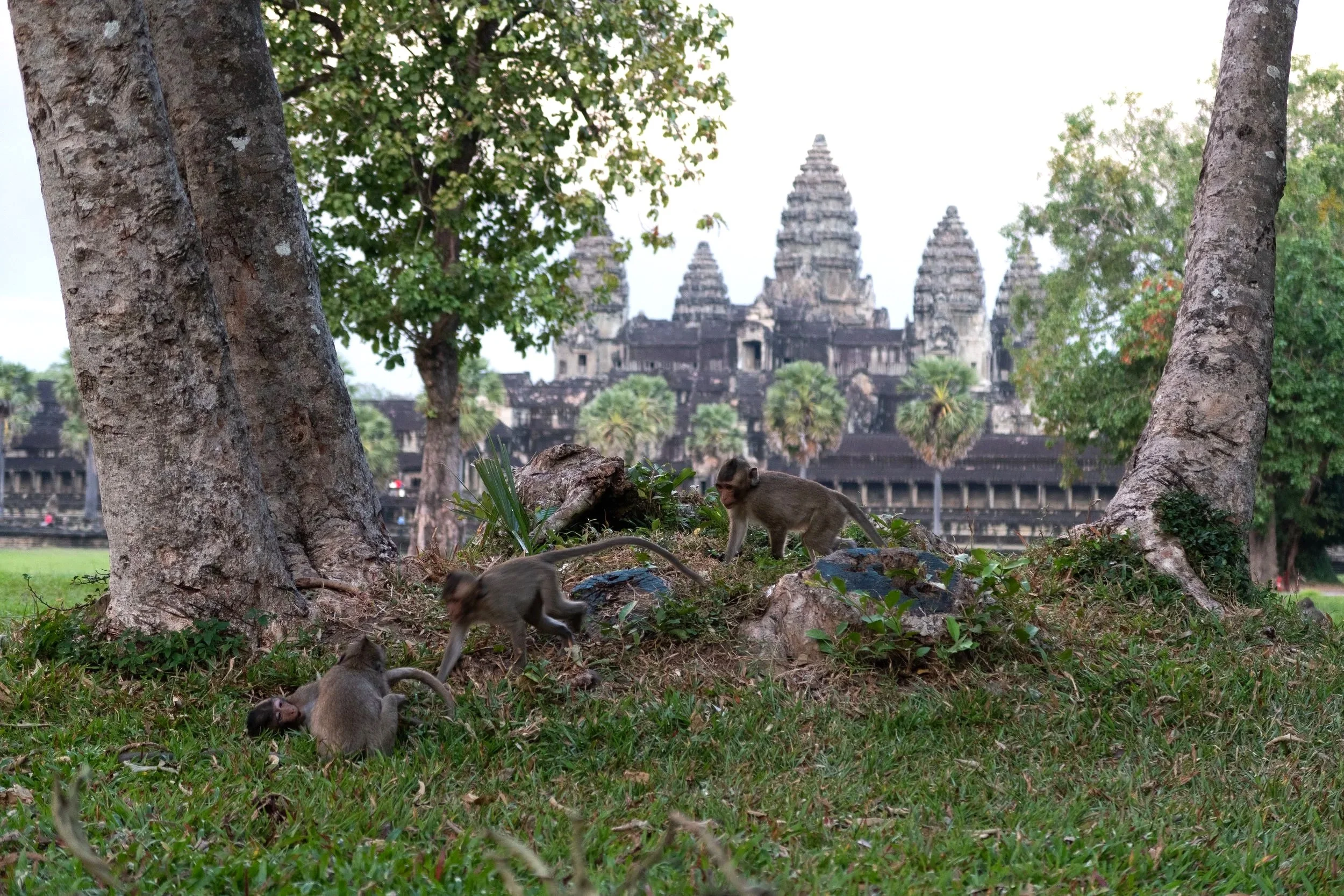
Without the group, the distances became more tangible. The heat became more tangible too. By late morning it settled over the stone and the roads with a kind of insistence that made even short walks feel deliberate. On my own, the movement between temples felt less seamless, more physical, and somehow more real because of it. And then there was the silence.
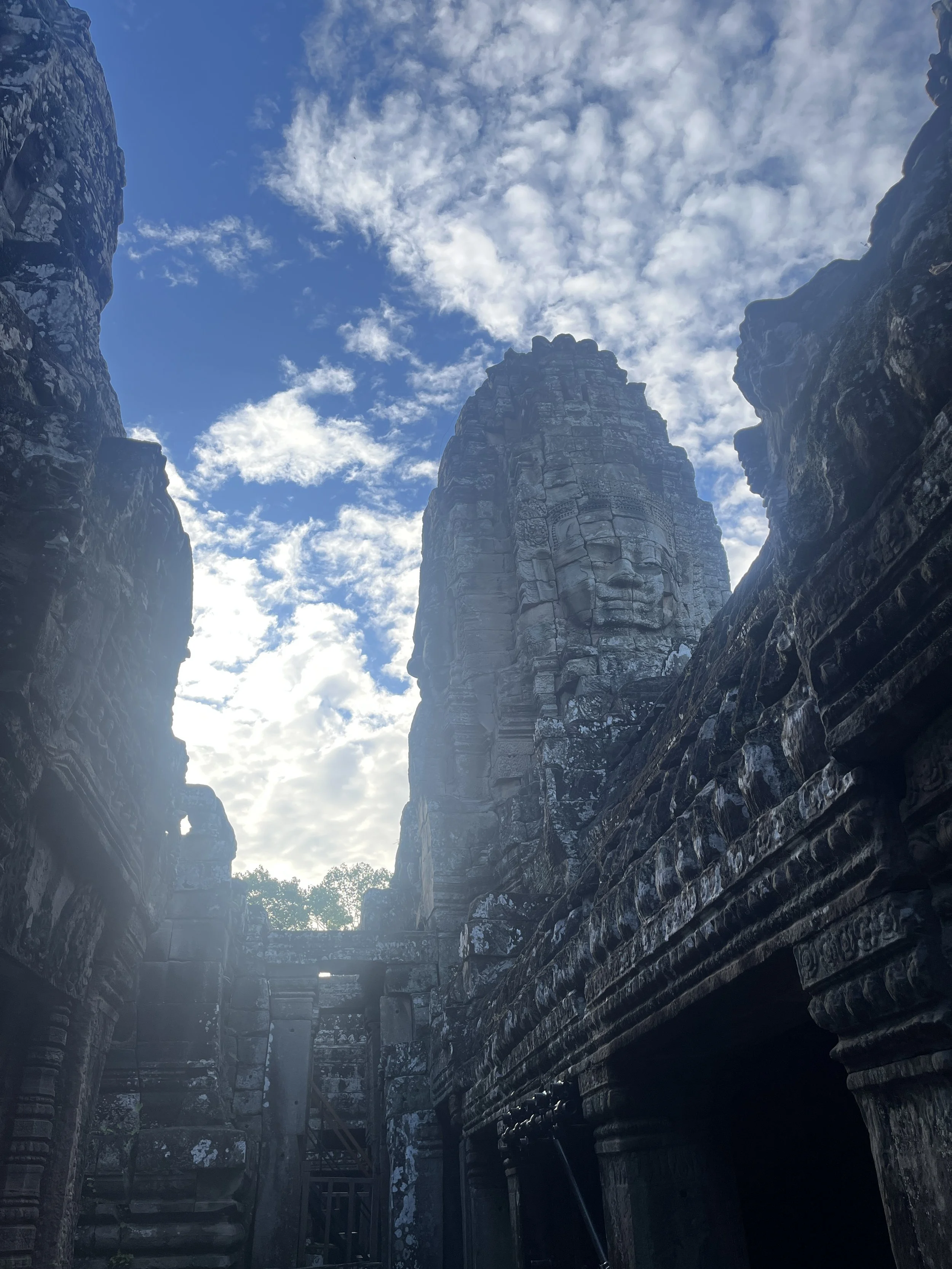
Not complete silence, of course. There were always sounds — cicadas, distant voices, the low hum of other tuk-tuks waiting in the shade — but compared to the guided tour, everything seemed to open up. I could stop where I wanted, stay where I wanted, and let my attention settle on things no guide would have reason to point out.
What impressed me most was not only the scale, but the care.
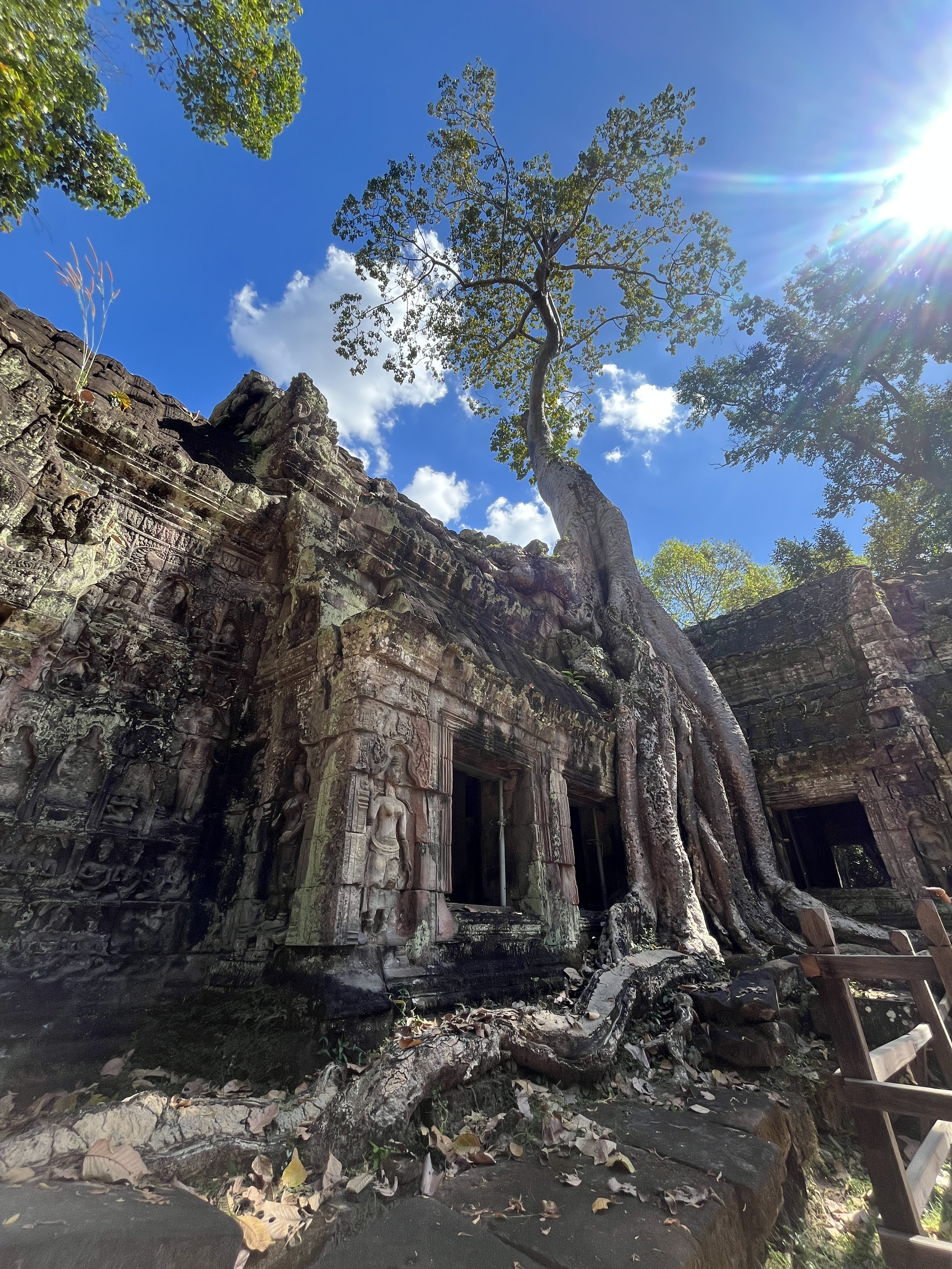
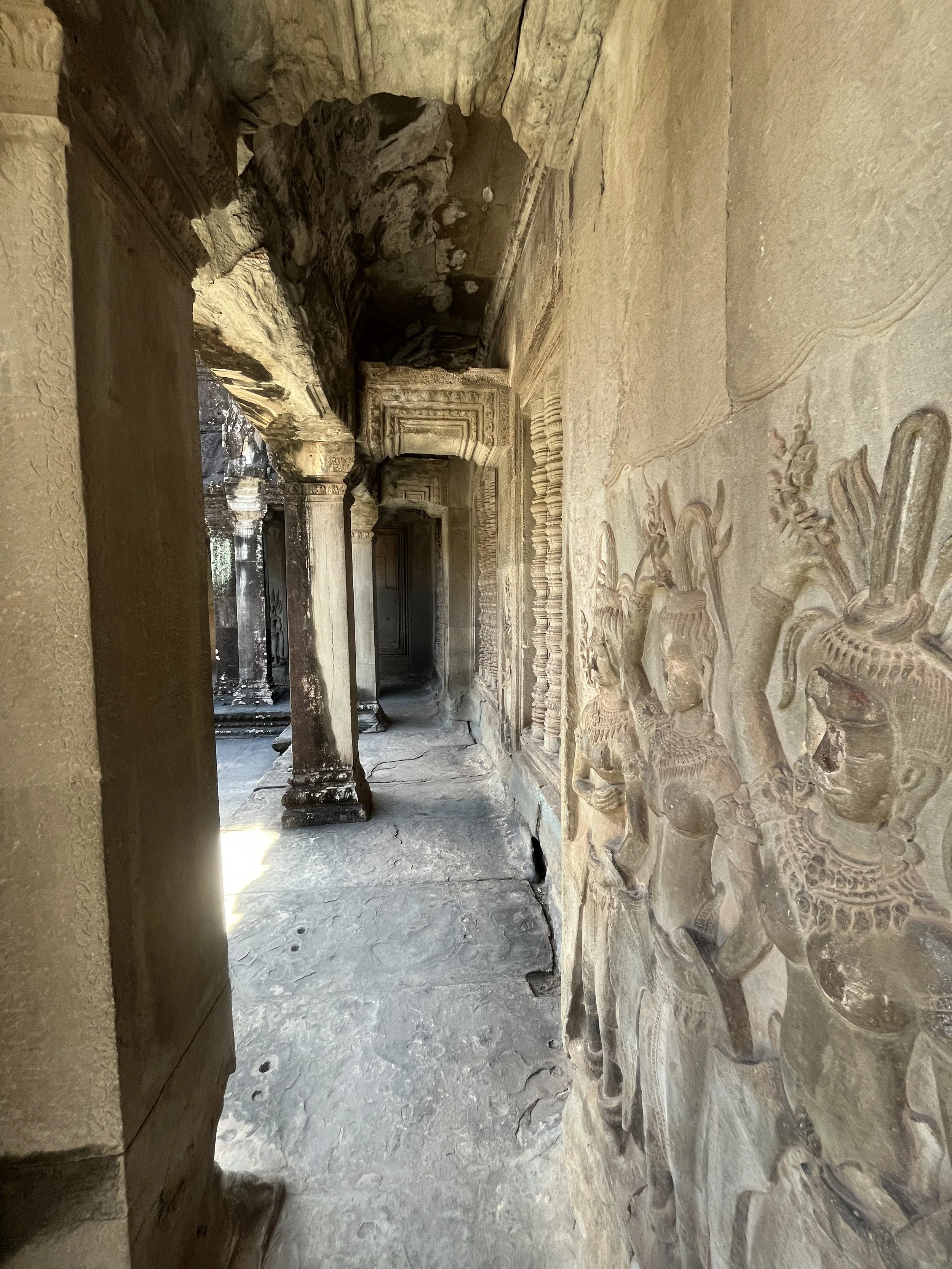
I have always been drawn to craft, especially to places where detail still seems to matter, where work leaves behind not only function but intention. Angkor is full of that kind of attention. Every wall seems to reward looking twice. Every surface carries the trace of someone’s hand. Stone is not treated as mass, but as something to be shaped patiently, repeatedly, with a level of care that feels almost difficult to imagine now.
You notice it in the carvings first. In the way figures remain distinct, in the rhythm of lines, in the sheer persistence of ornament. But after a while it is not just the beauty that stays with you. It is the labor inside it. The sense that someone spent years on details that were not strictly necessary for survival, profit, or speed, but were made nonetheless.
Walking through Angkor, I kept thinking about how different that feels from the logic of contemporary capitalism, where detail is so often the first thing declared inefficient, too expensive, not worth the effort. And yet here, surrounded by stone shaped with astonishing patience, it seemed obvious that beauty is never useless. It may not always be measurable, but it leaves something behind. It changes how a place is felt. It changes how a person moves through it.
Perhaps that is why Angkor never felt to me like a dead monument. Even in ruin, it feels intensely alive. Not only because of the trees pushing through walls or the light changing across the stone, but because the work itself is still visible. You are constantly confronted with human effort, with the stubborn desire to make something not merely grand, but beautiful.
Siem Reap, Beyond the Temples
What surprised me almost as much as Angkor was how easy it was to be in Siem Reap.
Not in the sense of simplicity — Cambodia is not simple, and its history certainly is not — but in the sense of rhythm. Daily life there slipped quickly into something gentle and manageable. I found it easy to walk, easy to stop, easy to stay longer than planned. As a woman traveling alone, that mattered to me. Whatever anxiety I had carried with me on the first night gradually gave way to something else: trust, or at least the beginning of it. People were kind in a way that felt unforced. Of course there was the usual choreography of tourist cities: invitations, smiles, repeated offers, little negotiations. But it never tipped into aggression. I never felt hunted by the place. I never felt that I had to harden myself in order to move through it.
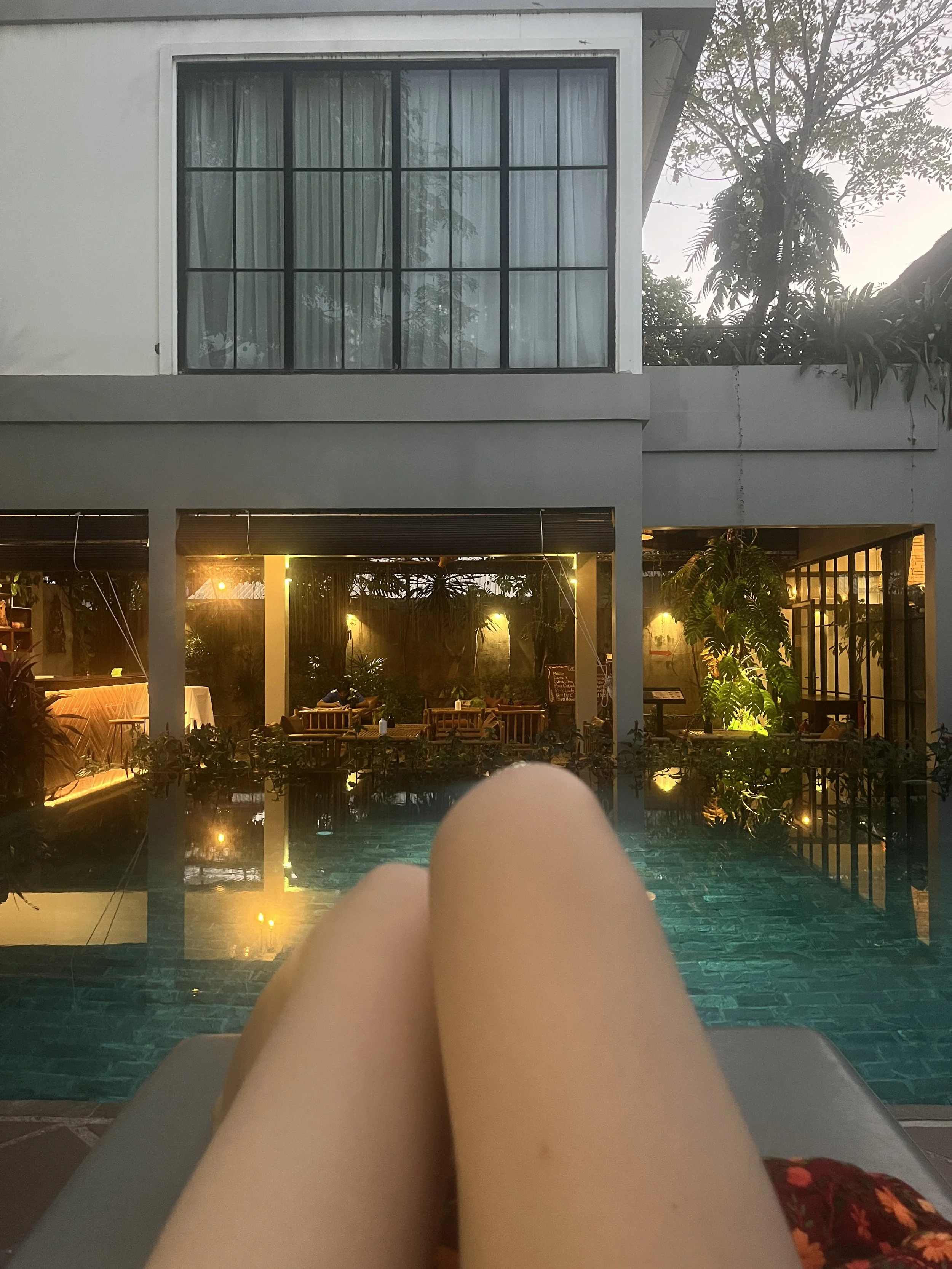
And so I began to notice other things.
The city itself is pleasant to linger in. The food is good, the bars are good, and both are affordable enough that staying out for dinner or stopping somewhere for a drink never feels like an event that has to be calculated first. Cambodia is, in that sense too, disarming. You can eat well without spending much. You can sit somewhere longer than intended. You can let a day extend into evening without feeling that the city is extracting something from you.
The money adds its own small layer of strangeness. It is useful — really necessary — to bring US dollars, because they are used everywhere. The visa is paid in US dollars, hotels quote in US dollars, and much of daily life runs on them. And yet you are often handed back Cambodian riel in change. After a while you find yourself holding thick notes printed with numbers so high they seem faintly absurd. For a moment you feel rich, then briefly confused, then adjusted. It becomes normal to pay in one currency and receive another, as if the country were operating in two registers at once.
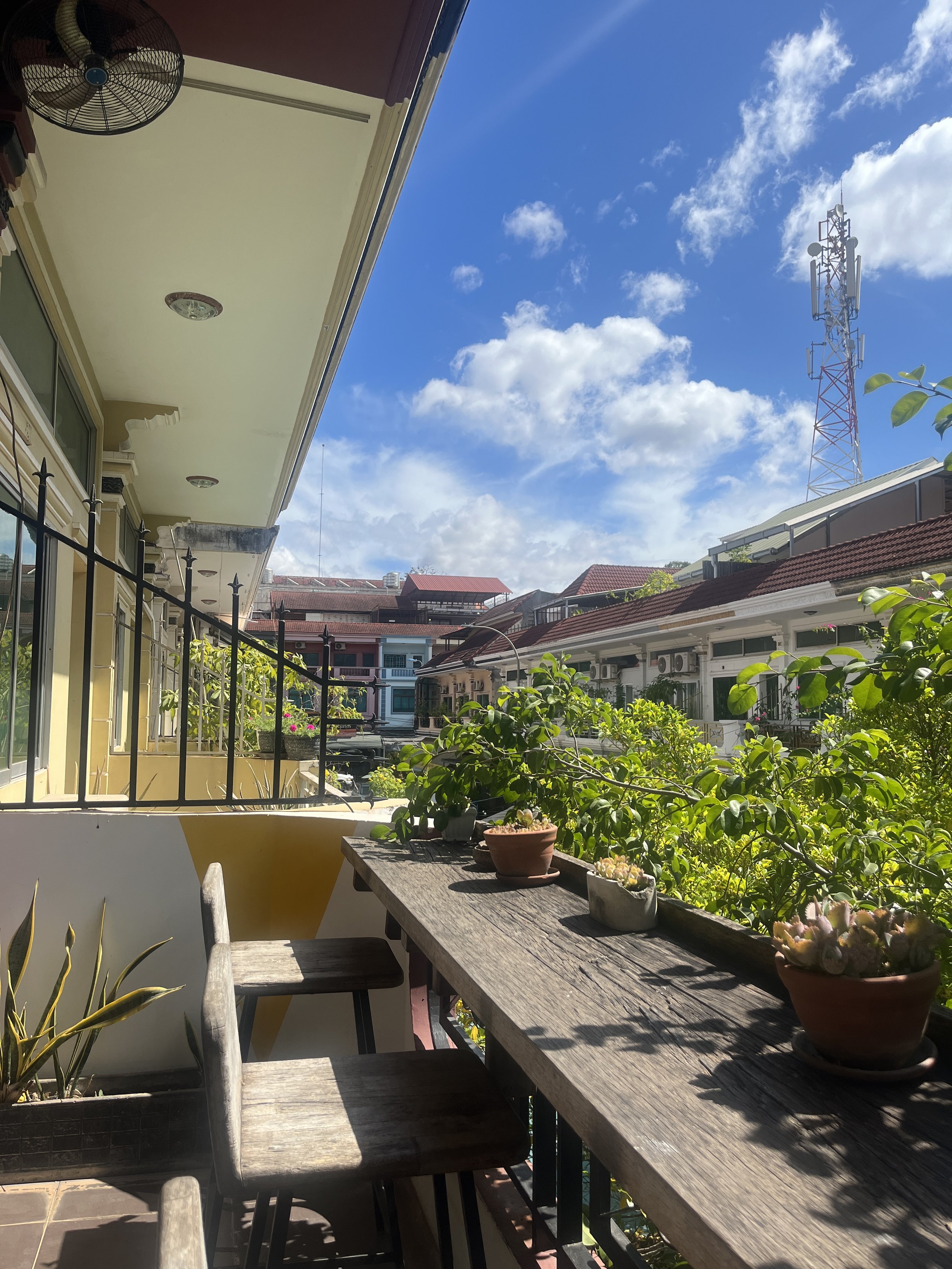
In the buildings, for instance, where traces of French Indochina remain visible in shutters, balconies, facades, proportions. The city does not feel frozen in a historical style. It feels accumulated. One period resting uneasily beside another. And then there were the other travelers.
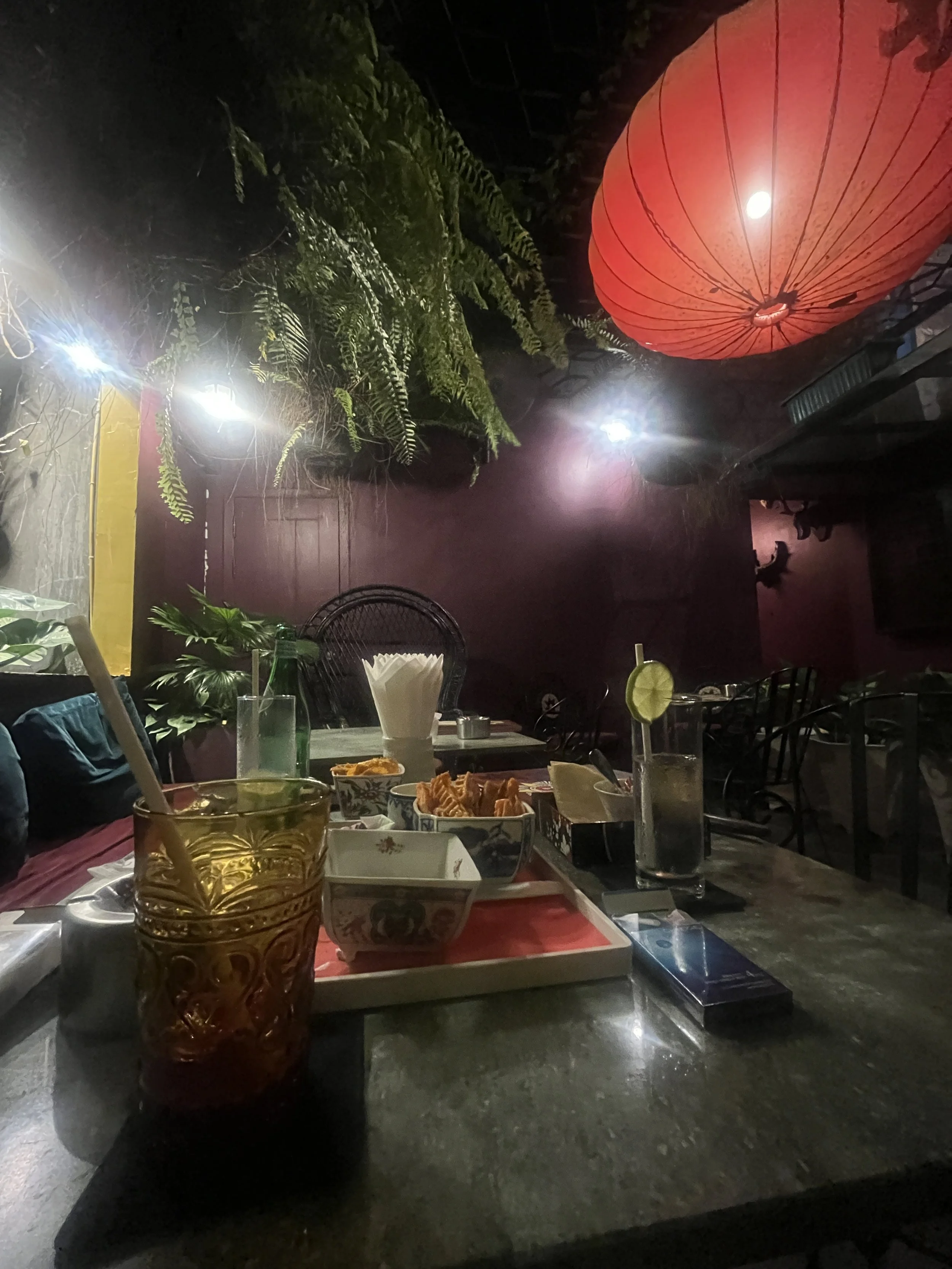
That may sound secondary, but it shaped the atmosphere of the place more than I expected. Siem Reap attracts many people who are not simply rushing through to tick off Angkor at sunrise and leave again. I met travelers who cared deeply about culture, who were willing to sit still, to look, to let the place work on them a little. That changes the air around a city. It makes conversation more interesting. The more time I spent there, the less Cambodia felt like “Angkor and surroundings” and the more it began to feel like a country I had only just started to glimpse. I had arrived with one clear image in mind: the famous temples, the great stone inheritance of the Khmer Empire, a place I had wanted to see for years as a historian. But by the end, what stayed with me was not only the grandeur of Angkor. It was the feeling of a country extending far beyond it.
And that is why I know I want to return.
Not only to see more, though there is clearly more to see, but because Cambodia already feels to me like one of the most beautiful places in Asia. Not in a polished or easy sense, but in a way that keeps unfolding. A place whose beauty lies not only in what it shows immediately, but in what it gradually allows you to notice.